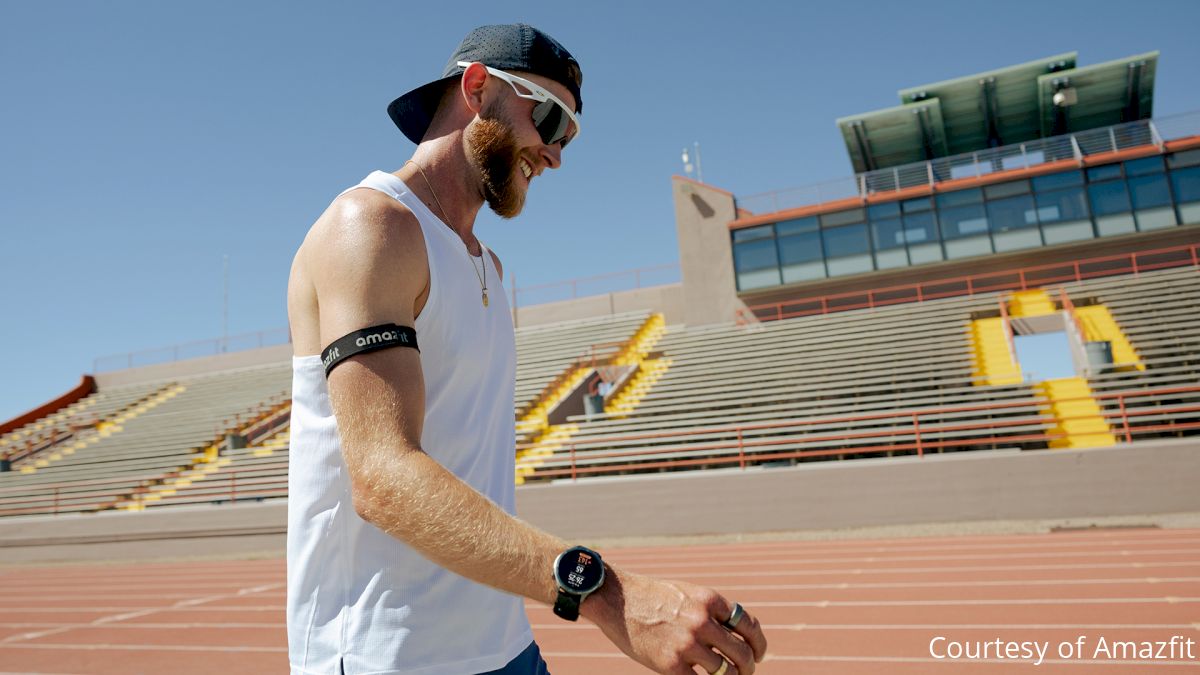
In Partnership with Amazfit
On July 18, Josh Kerr will chase the world record in the mile, but he’s also chasing a feeling on the track.
When the gun goes off at London Stadium, the Olympic silver medalist wants to hear the roar of the crowd—filled with fans from his home country—go silent with anticipation. When he glides around the turn into the homestretch, Kerr wants to hear competitors’ spikes hit the track. In that singular moment, the 1500-meter world champion wants to hear the rhythm of his steady breath as he embraces a career-defining opportunity.
US Audiences can watch Kerr's World Record Mile attempt LIVE on FloTrack. Coverage begins at 8:15 AM ET.
- Subscribe To Watch the 2026 Diamond League on FloTrack
- Watch the 2026 London Diamond League Meeting LIVE on FloTrack
- The Gear Powering Josh Kerr's World Record Attempt
- Josh Kerr To Make WR Attempt At London Diamond League Meeting
“That’s what I’m chasing with this record—full flow—like I’ve done every single thing I can. I’m now giving my body and my mind over to this experience,” Kerr says. “That’s living for me.”
For Kerr, reaching his peak for the record attempt at the Diamond League in London was a meticulous process of honing his body’s needs with data metrics. Using Amazfit wearable technology, the Scottish middle-distance runner gained an acute understanding of his sleep, recovery, and heart rate variability (HRV)—to level up his training like never before.
A Journey With Numbers
At different points in his running career, Kerr struggled with the concept of tracking data in training. During the buildup to the 2024 Paris Games, the five-time global medalist removed his smart watch in sessions because he didn’t want to know the numbers behind his body’s response to the training load.
But in the beginning stages of the London buildup, Kerr experienced a major mental shift that changed his approach. In pursuit of the elusive mile world record—3:43.13 set by Hicham El Guerrouj in 1999—Kerr realized precision is key when chasing a time that’s over two seconds faster than his current personal best. And being armed with data points ultimately supports his recovery, training consistency, and collaboration with his longtime coach, Danny Mackey.
“Things do not need to go perfectly, but you need to track what you're doing or else you're just going to lose—you're going to lose the percentage that you were hoping to gain from doing those sessions,” Kerr, 28, says.
For example, wearing the Helio Ring helped Kerr gain an understanding of his sleep patterns by tracking his sleep quality and heart rate variability for comprehensive insights on his recovery throughout the training cycle.
Based on his sleep scores, Kerr aims to get at least eight hours of sleep at night and 90 minutes of sleep during the day. Those sleep windows are done in a bedroom altitude chamber, which allows him to reap the training benefits of being between 9,000 and 10,000 feet of elevation while still living at 5,300 feet in Albuquerque, New Mexico. Kerr also has his bedroom set up to distribute the oxygen he’s pumping out of his room into his gym in the garage, so his gym is at sea level. This feature allows Kerr to utilize three different altitude environments at all times.
“If recovery is starting to see numbers that I don't want, then we can just jump in there and do a recovery nap [at sea level],” Kerr says.
Experimenting With The Help Of Data
While much of Kerr’s focus has been on winning medals at global championships, this season’s goal presents a rare chance to focus on running a time no other athlete has ever achieved. Every millisecond matters, and every decision leading up to the race can affect how his body responds to the challenge.
Equipped with HRV data—a measure of the tiny fluctuations in timing between heart beats—from his Helio Ring and smart watch, Kerr and Mackey experimented with periodization in the five weeks leading up to the record attempt in London. Kerr says his typical HRV is around 86 and rarely goes above 90. According to medical experts, a high HRV is linked to better cardiac health, which suggests the heart is subtly yet rapidly adapting to changes happening throughout the body. Understanding Kerr’s HRV and recovery data also helps Mackey guide him through specific heart rate zones in a way that avoids overtraining.
In trying different intensity levels and training loads just over a month before the record attempt, the pair aimed to predict how Kerr’s body would react to stimulus and ultimately determine how best to taper—with the goal of having Kerr’s HRV peak on race day.
While there’s been heavy emphasis on recent data points, Kerr maintains a greater perspective on his decades-long progression in the sport—and the incredible effort to get there. “Everyone's getting so much faster every year, and the way that I get fast is stacking,” he says. “I'm stacking years, I'm stacking days, I'm stacking months.”
With practically every measure explored in order to reach his full potential in London, Kerr is now embracing the thrill of pursuing something unprecedented on Saturday.
“If you can stand on a start line with a filled cup, you’re ready to go to war,” Kerr says.
Don’t Miss A Second Of The 2026 Diamond League
The Diamond League is streaming live on FloTrack and the FloSports app. FloTrack’s Diamond League coverage includes live events, replays, videos and articles throughout the season.
Where To Watch Diamond League?
The Wanda Diamond League will be broadcast on FloTrack and the FloSports app.
FloTrack Archived Footage
Video footage from each event will be archived and stored in a video library for FloTrack subscribers to watch for the duration of their subscriptions.
Join The Track & Field Conversation On Social
- Follow us on Twitter @FloTrack
- Follow us on Instagram @flotrack
- Follow us on TikTok @flotracktv
- Watch us on YouTube
- Like us on Facebook