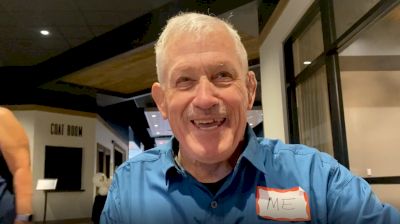
Leroy Vega was a virtual lock to reach the 125-pound finals at the 2002 NCAA Championships. The University of Minnesota senior won the Big Tens and was undefeated on the season after finishing fifth, fifth, and third at nationals the previous three years.
Except it didn’t happen. Vega was bounced in the second round and failed to place during his last college tournament.
That’s the first thing Vega remembered when former Minnesota coach J Robinson passed on March 29, 2026, at 79.
“We won nationals that year, and he stayed in my room all night because he knew I was in a bad place,” Vega said. “That man has impacted my life more than I could explain. I didn’t grow up with a grandpa, so having J there as a grandpa figure was nice. He’s always been there for me.”
Robinson proved it again when Vega was in a bind as a high school wrestling coach. A college coach was scheduled to speak at a golf tournament on Saturday, but canceled on Friday. Vega reached Robinson in California for advice.
“I woke up the next morning at the golf outing, and my dad pulled up with J Robinson,” Vega said. “J called my dad and showed up at the golf outing, spoke at the event, and left that day.”
Making The Gophers Golden
Robinson was a complicated, enigmatic, and polarizing figure in a sport that, in his mind, holds itself back. That, above all else, drove Robinson crazy. He wanted progress, and college wrestling moved at glacial speed.
J wanted duals with consequences. The best dual team in the nation should be the NCAA team champion. Period. The NCAA tournament is for crowning the best individuals.
The former Army Ranger was an assistant at the University of Iowa from 1972 through 1984 alongside Dan Gable. The Gable-Robinson duo took the Hawkeyes to new heights, winning seven of eight NCAA titles from 1977 to 1984 while Gable was head coach.
Robinson didn’t leave Iowa City on good terms. He clashed with the University of Iowa over Iowa Intensive Camps, eventually leading to J Robinson Intensive Camps and a head coaching role at Minnesota during the 1986-87 season.
His mission was to take down the Hawkeyes, which he eventually did.
The road was more challenging than Robinson imagined. He created a plan to win the 1989 NCAA Championships. It took another 12 years to get it done.
Taking down Iowa was important to J. Winning his first NCAA team title with 10 All-Americans and no finalists in 2001 at Carver-Hawkeye Arena was completely gratifying — especially when Iowa finished second.
Then Minnesota won another title in 2002, and another in 2007. In all, Robinson led the Golden Gophers to 12 NCAA team trophies (given to the top four) during his 30-year head-coaching career at Minnesota. He was also the first coach outside of an Iowa or Oklahoma school to win multiple NCAA team titles.
“J Robinson was the exact guy I needed after taking over for Gary Kurdelmeier (in 1976),” Gable said. “We worked well together until he left for Minnesota. Then we competed against each other and made college wrestling even stronger.
“He told me he wished he had never left Iowa. I disagree. Leaving for Minnesota helped the sport evolve.”
The Complexities Of J
Robinson knew other coaches criticized his program and his approach. On one occasion, he held out his ring finger and said, “Have them come talk to me when they win one of these.” Meaning an NCAA team championship, of course.
Robinson pushed the boundaries of what’s possible. He understood that creating a fan base was important, but getting on television was more important.
Minnesota set a dual attendance record of 15,646 on February 2, 2002, in the Target Center when the Golden Gophers hosted the Border Brawl against Iowa.
More than that, Robinson returned phone calls, provided commentary, and got others involved. There was something about J that drew you in. He captured your imagination — even if it upset you.
It was a rite of passage to get angry at J — and then forgive him.
Robinson's confident public persona suggested he was outgoing, but he confessed to being naturally shy and felt apprehensive about asking questions during a military history seminar he attended.
He also liked Britney Spears and sang along with “Stronger” in his Jeep as he left one of his camps. His favorite prank was when he hosted a party and pretended to play the piano for a stunned audience, only for them to realize it was a player piano once he finished.
Deep conversations held a special place. He spoke about how his parents never had to tell him they loved him since they proved it to him his entire life through action, not words.
Robinson held strong philosophies on a variety of subjects. And, because he was so outspoken and repetitive, it was easy to remember J’s deeply held beliefs.
“I hate it when people use my own philosophies against me,” Robinson often said. “Do as I say, not as I do.”
And then there were his quotes. He had hundreds. His favorite was, “I'm not very smart, but I can take what other people do and make it work for me.”
There were others, like “The teacher does not interfere with the pupil while he takes the test,” or “The greatest gift is to be yourself in a world that’s trying to make you like everything else,” or, classic Yoda, “Do or do not, there is no try.”
Some will remember the unceremonious ending to his college coaching career in 2016, when he was let go at Minnesota after allegations that some of his wrestlers misused prescription drugs. That’s a small speed bump for a man who influenced thousands through his camps, coaching, and commentary.
Few can say they have advanced an entire sport. Captain J Paul Robinson forced wrestling to move forward — even when it didn’t want to.