Ireland's Paris Wake-Up Call And The Reset Required Before Rugby World Cup
Ireland's Paris Wake-Up Call And The Reset Required Before Rugby World Cup
Ireland’s loss to France exposed deeper issues around selection, tactics & coaching, as Andy Farrell faces key decisions on the road to the Rugby World Cup.
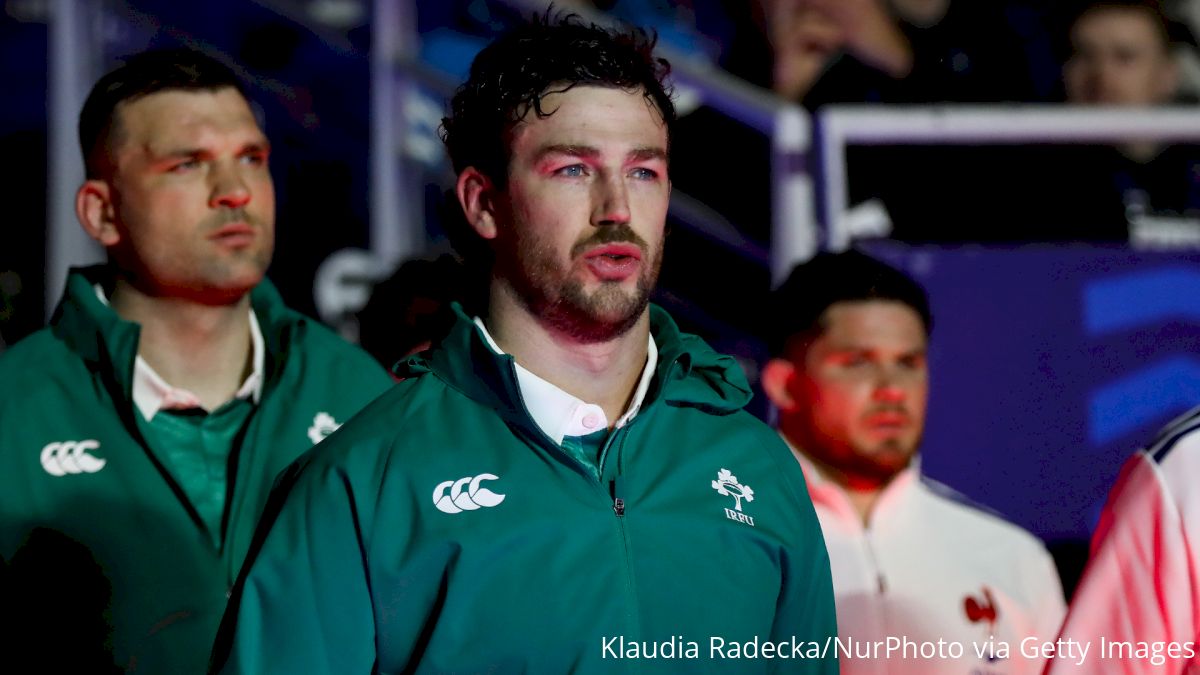
Andy Farrell described Ireland’s Six Nations defeat in Paris as one that would “stick with the team.”
In truth, it should stick with Irish rugby as a whole, because what unfolded at the Stade de France was not a one-off malfunction. It was the clearest expression yet of a slow, uncomfortable regression that has been gathering pace since the 2023 Rugby World Cup.
- More Information On Investec Champions Cup On FloRugby
- More Information On PREM Rugby On FloRugby
- See Every Rugby Europe Match Streaming On FloRugby
- FloRugby's Professional Club Power Rankings: Feb. 4, 2026
Trailing 22-0 at halftime, Ireland was not simply outplayed. Ireland was outthought, outmuscled and outmaneuvered by a French side that understood exactly where the contest would be decided and attacked those areas with conviction.
The aerial contest, the breakdown, the point of contact and the tactical kicking battle all were lost long before the final whistle.
That does not happen to elite sides by accident.
Since the high watermark of the 2022-2023 season, Ireland has lost four of its last five matches against top-5 opposition.
In isolation, that statistic does not spell collapse. In context, it tells a far more revealing story.
Ireland no longer is operating in the small group of teams that dictate terms regardless of venue or opposition. Ireland now is on the edge of that group, still competitive, but no longer imposing.
A degree of regression always was inevitable.
Irish rugby enjoyed a sustained period of excellence built around generational figures. Johnny Sexton, Conor Murray, Peter O’Mahony and Cian Healy were not just elite players, they were cultural anchors who straddled Irish Rugby's innovative generation of the 2000s and the latest crop of world class operators.
Their departure removed decision makers, tone setters and emotional ballast in one sweep.
What followed was not a rebuild, but a holding pattern that, combined with Farrell's Lions sabbatical, has put Irish Rugby on the back foot.
Instead of aggressively refreshing ideas and personnel post World Cup, Ireland doubled down on what had worked before.
Continuity was prioritized over competition within the wider playing pool. Loyalty was valued over disruption. That approach made emotional sense after the disappointment of Paris 2023, but it ignored the reality of elite sport. Teams do not stand still. They either evolve, or they are overtaken.
France and South Africa chose evolution in the immediate aftermath of arguably the greatest World Cup tournament to date. Ireland, conversely, chose familiarity with a group that took the team to new heights before a bitterly disappointing quarterfinal exit.
Nowhere is that more apparent than at out-half.
The post-Sexton transition always was going to define this cycle, yet Ireland attempted to replicate his influence, rather than redesigning how the position functions within the system.
Jack Crowley delivered a Six Nations title in 2024 and played a key role in securing a historic series draw with the world-champion Springboks in their own backyard.
In this same window, Ciaran Frawley showed his ability to handle pressure moments with two big-time drop goals to down the Boks in Durban.
Both were imperfect, but both were progressing and crucially showed the aptitude needed to perform at the top level.
The decision to fast track Sam Prendergast changed the dynamic entirely.
Backed publicly and immediately, he was elevated into a role that demanded authority before he had the chance to grow into it. The belief in his talent is understandable. The handling of his development is far harder to justify.
Prendergast’s attacking gifts are obvious when Leinster and Ireland are dominant. When they are not, he struggles to impose himself.
That is not an indictment of a young player with immense upside, but it is a predictable outcome of premature responsibility.
At the same time, Crowley and Frawley now operate under constant threat, unable to play with freedom or authority in the limited opportunities afforded to them.
The result is three out-halves, all capable, but none settled. And, crucially, none are better positioned to take Ireland a step or two further than the squad went in 2023.
Tactical Mismatch
The tactical approach in Paris only compounded Ireland's issues.
Ireland arrived with a clear plan to dominate territory and the air. It was a reasonable idea, given the conditions and the quality of opposition. What was unreasonable, was the refusal to adapt once it became obvious that France was winning those exchanges comfortably.
Repeatedly kicking contestable ball to a French back three that was better organized, more athletic and better supported was an act of tactical stubbornness. More damaging was Ireland’s inability to capitalize on loose ball.
French chasers hunted in numbers and in waves, shifting from defense to attack in a flash. Ireland clustered without clarity, leaving space everywhere else, which was ruthlessly exposed.
Antoine Dupont’s influence illustrated the contrast. His kicking game was not just accurate, it was intelligent. Contestable when support was in place, probing when space appeared. Ireland never found that balance. Defensively, the Irish looked caught between systems, unsure whether to blitz or hold shape, and were punished accordingly.
What made this more concerning was that improvement only arrived when Ireland was forced into change.
The introduction of Crowley as a second distributor immediately altered the picture. With another playmaker in the line, Prendergast found time and space that had not existed previously. Ireland’s best attacking moments came when they abandoned rigidity and embraced variation with the team's two most creative players.
That pattern has emerged before when the two have featured together, yet has rarely been acted upon.
Selection policy tells a similar story.
Farrell’s trust in his core group has been absolute. That trust delivered results between 2022 and 2024. It has now begun to dull competition. Players such as Andrew Porter starting 15 consecutive Six Nations matches speaks less to depth and more to a lack of genuine internal pressure.
Since the World Cup, Ireland has had multiple fixtures where results could have been secured while expanding the player pool. Those opportunities were largely missed. Depth in key areas remains theoretical, rather than tested, and when injuries or loss of form arrive, options feel reactive, rather than prepared.
Even the coaching structure reflects this inertia.
Ireland remains the most settled coaching group among tier one nations. Stability brought success. It is now flirting with stagnation. Outside of one change in the attack department, with Mike Catt being replaced by Andrew Goodman, ideas and voices have remained consistent, even as performance indicators have dipped.
Paris did not create these issues. It exposed them under the brightest lights.
How Ireland Can Still Reset The Narrative On The Road To 2027
The danger in moments like this is overcorrection. Ireland does not need to tear down what has been built. Ireland needs to accept that the next phase will not look like the last one.
There are clear, achievable steps that can be taken to reframe the narrative between now and the 2027 Rugby World Cup.
The first is to accept that the out-half debate cannot be solved by rotation alone. Ireland needs clarity, but clarity does not mean crowning a single successor. It means redefining how playmaking responsibility is shared.
Modern international rugby increasingly favors dual playmaking models.
New Zealand, South Africa, France and Argentina have embraced systems where decision-making is distributed, rather than centralized. Ireland has the personnel to do the same.
Crowley and Frawley both are comfortable operating outside 10. Prendergast has shown that his best moments come when he is not the sole conductor.
Using two distributors would reduce pressure, increase adaptability and make Ireland far harder to defend. It also would allow young players to develop within structure, rather than being crushed by the expectation of becoming Sexton 2.0.
The second priority is to build on the genuine positives that emerged in Paris.
Ireland’s se-piece showed real progress. The scrum held firm against one of the most powerful packs in world rugby, and the line-out improved significantly with the inclusion of Cian Prendergast being a key catalyst.
This progress has the potential to go one step forward with the addition of dynamic young players such as Edwin Edogbo, Cormac Izuchukwu, Brian Gleeson and Bryn Ward over the coming months. Additionally the return of Andrew Porter, Paddy McCarthy, Oli Jager and Jack Boyle will add some valuable prop depth.
These gains matter.
Set-piece stability provides breathing room for backs, especially those who are still finding their feet and/or low on confidence. It must be treated as a platform, rather than a footnote, particularly against opponents who will look to replicate France’s physical approach.
Depth development no longer can be deferred by Farrell and company.
High-performance environments require a level of necessary friction. Ireland’s setup appears to have softened significantly since the high point of the Joe Schmidt era, with Connor Murray's recent comments around players not being called out confirming this narrative.
Players must feel that jerseys are earned weekly, not protected by past service. That means meaningful minutes for those on the edges of the squad, not token appearances once outcomes are decided or against Tier 2 nations.
The same principle applies to the coaching group.
Fresh ideas do not undermine leadership, they strengthen it. Farrell has built a culture of trust and clarity. The next step is to invite challenge. Irish rugby has no shortage of high-level coaches operating abroad who could bring new perspectives without dismantling the existing framework.
This is not about replacing Farrell. It is about surrounding him with voices who will ask uncomfortable questions and offer alternative solutions.
Of the options that could be explored, three of the leading contenders are Irish.
In the attacking department, Noel McNamara and Nigel Carolan are orchestrating two of club rugby's most potent attacks. Up front, Donnacha Ryan has transitioned from line-out general to world-class forward coach at La Rochelle.
Should Farrell look further afield, Northampton's Sam Vesty has developed the back line that now forms the spine of England's lethal attacking game, which at the time of writing, is on a 12-match winning streak.
The road to Australia remains open.
Ireland is not in decline, but in transition, whether the team chooses to acknowledge it or not.
Paris was not a dead end. It was a warning, as was the case for South Africa in Dublin back in 2017, and we all know how that has since played out.
What happens next will define whether this generation becomes another near-miss, or the foundation for something more enduring.
How To Watch Rugby Matches In The United States On FloRugby
Professional club rugby in Europe all streams on FloRugby and the FloSports app in the United States. FloRugby and FloSports also are the U.S. home to:
- United Rugby Championship
- PREM Rugby
- Top 14
- Investec Champions Cup
- EPCR Challenge Cup
- Currie Cup
- Super Rugby
- And more
FloRugby also is home to match archives and match replays.